


Sixth-round picks rarely change a season. Every so often they change a plan. Anez Cooper is worth watching for the second reason, not the first.
Why Anez Cooper matters to the Jets’ guard plan
The Jets took Cooper with pick No. 188 in the sixth round of the 2026 NFL Draft, and they moved up 11 places to do it through a pick swap with Seattle, according to the team’s own draft profile. That is a small move by draft-weekend standards. It is also the kind of move that only pays off on a longer timeline.
The useful question with a pick like this is not whether he wins a job in August. It is whether the Jets can turn an experienced, physically unusual college right guard into a real interior option before the more expensive offensive-line decisions arrive. Guard is a position where teams either develop cheap answers internally or pay market rates for someone else’s answer later. Cooper is a bet on the first path.
That is what separates him from most of the Jets’ 2026 draft class in terms of how you should judge him. The early picks get graded on production. A pick at No. 188 gets graded as a developmental investment, on whether the coaching staff can build something out of a late-round selection over time.
The experience profile New York traded up for
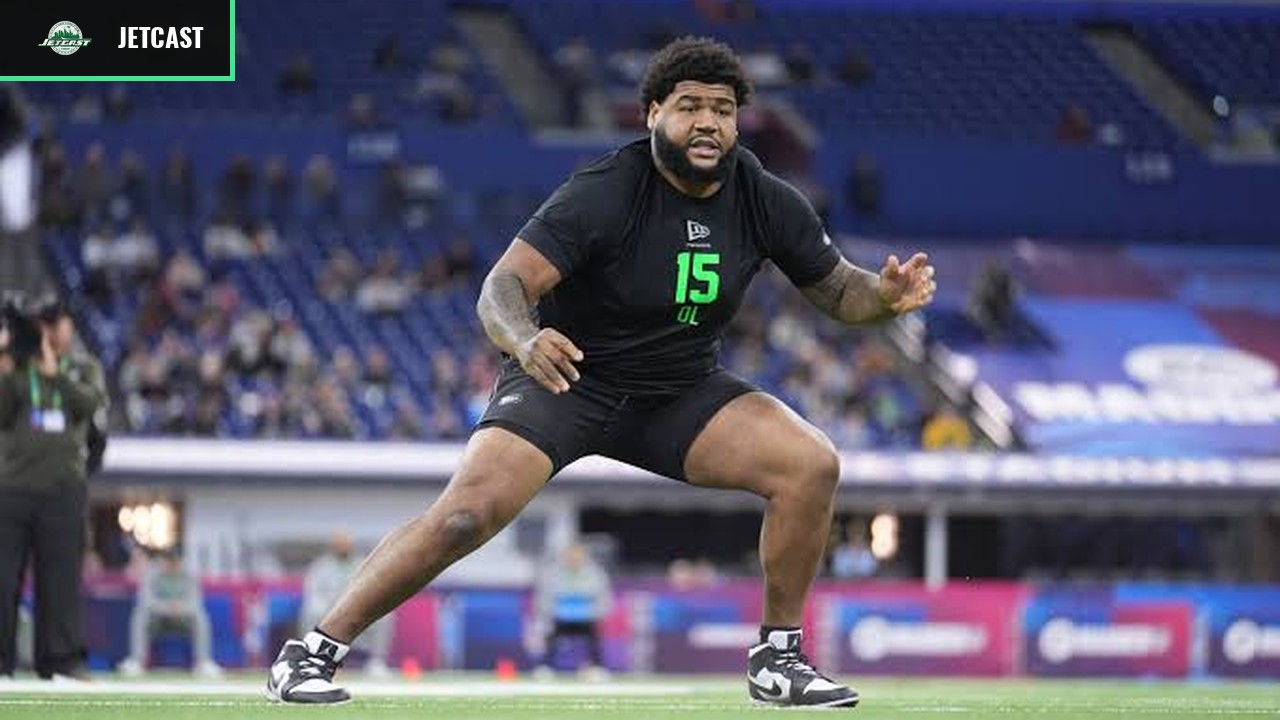
The verified profile is genuinely unusual. The official Jets draft profile lists Cooper at 6 feet 5 inches and 334 pounds, with 45 starts at right guard for Miami and more than 3,000 collegiate offensive snaps. It also credits him with All-ACC honors in each of his final three seasons.
The number that gets quoted most often needs its full attribution. The Jets’ own article, citing Pro Football Focus, says Cooper allowed no sacks on 816 pass-blocking snaps in his final college season. That is PFF’s charting, relayed by the team, and it is worth exactly what a clean pass-blocking chart against ACC competition is worth. It is not JetCast’s own film work, and nobody should treat it as a projection.
The honest read on the whole package: this is a lineman with an enormous amount of live college reps at one position, at a size that is rare even in an NFL interior. None of that is proof of anything at the next level. Snap volume tells you a player has been coached, trusted and put through the same game situations again and again. It does not tell you he can handle NFL hand technique, interior quickness or the speed of the games inside. Size tells you even less. Plenty of 334-pound guards never solve professional pass rush, and the ones who do usually solve it with feet and timing rather than mass.
Where Cooper fits in the 2026 offensive-line room
As of now, the official NFL.com Jets roster lists Cooper as an active rookie guard wearing No. 72, at 77 inches and 334 pounds, out of Miami. That is the roster fact. Everything past it is projection, and this is the point in the summer where projection gets sloppy.
The realistic frame is the offensive-line roster math. Teams carry a finite number of linemen, and the back half of that group is decided less by upside than by trust. A developmental interior player makes a roster when a coaching staff believes it can put him in a game without redesigning the protection plan around him. That is the bar Cooper is actually competing against, and it is a different bar than beating out a veteran for a starting spot.
JetCast is not going to tell you he has passed anyone on a depth chart. No current official source establishes that, and August depth-chart chatter is the least reliable information of the year.
What training camp must reveal
Camp is not going to answer whether Cooper becomes a starter. It can answer narrower things, and those are the ones worth tracking.
The first is whether the college technique holds up when the athletes across from him are professionals. The second is whether he can absorb an NFL protection install at the speed the room moves, since interior linemen carry more of the communication load than fans usually credit. The third is simply how he responds to difficult reps, because camp can show whether a technical problem gets cleaned up or keeps repeating against the same kind of rusher.
The topic is live enough that others are asking similar questions. Gang Green Nation published a piece on July 28, 2026 titled Anez Cooper’s development is a test for the Jets. The framing here is our own, and the timing tells you only that the subject is current in late July. Current interest in a developmental lineman is not a depth-chart conclusion, and it should not be turned into one.
What a successful rookie season would look like
Set the standard correctly and this gets much easier to evaluate.
By JetCast’s standard, a successful 2026 for Cooper is developing enough that he remains part of the Jets’ plans for the interior line going forward, even if he never starts a game. That is our analysis and not a team statement. No starts required. No highlight reel required.
That standard is worth remembering. Jets fans have already seen how slowly offensive-line answers actually arrive, including in the development of Armand Membou, which was a different situation with different expectations and a different level of investment. The two players are not comparable in role. What carries over is the process: an offensive lineman is judged over months, not over one padded practice that goes viral.
The JetCast bottom line
Cooper is not a solution and he is not a camp story. He is a low-cost swing at a position where cheap internal answers are worth real money, taken by a staff that clearly wanted him enough to move up 11 spots for him.
Judge the pick on development, not on August depth charts. If he develops into a credible interior option, the trade up can be judged favorably as smart roster construction and a small piece of the new regime’s roster-building grade. If he does not, the cost was limited to a late-round selection and the 11 spots the Jets moved up to get him. That is a reasonable price for the question they are trying to answer.