


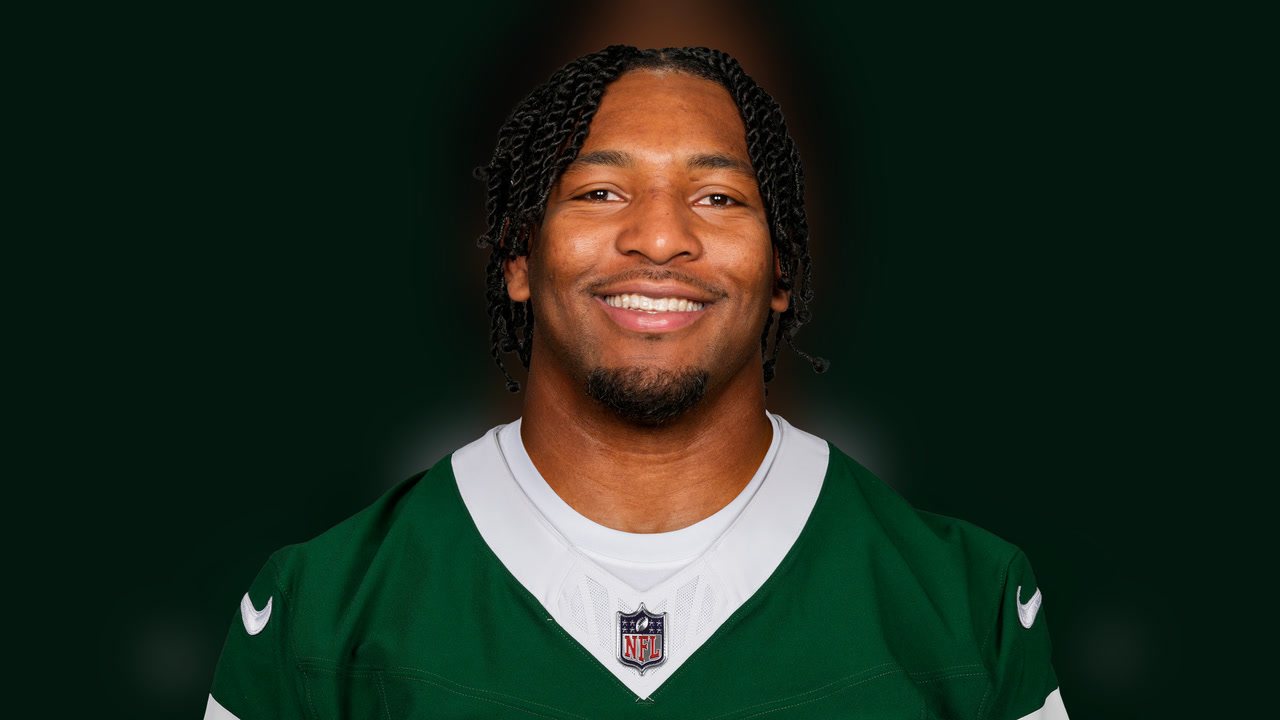
The Kingsley Enagbare Jets role is one of the easier things to misread in late July, because the reflex with any edge addition is to guess at a sack number and move on. That framing does not fit this signing. NFL.com currently lists him as active for New York, and his league profile has him at No. 52, listed as a linebacker, 6 feet 4 inches and 258 pounds, with five years of experience out of South Carolina. None of that tells you what he is supposed to do on first and 10.
The more useful question is what shape the Jets want their front to hold across a full series. New York spent this offseason reworking an edge group that did not function well in either phase, and the sensible version of this addition is not a third player chasing the quarterback from a wide alignment. It is a player who gives Aaron Glenn a front that can play early downs without leaking, so the pass rushers get to rush in situations that favor them.
That role is a plan, not a result. Training camp has to make it real.
Why the Jets Needed a Different Kind of Edge Defender
Jets Wire, in its July 27 look at where Enagbare fits, noted that the Jets finished 31st in sacks and 29th in rushing defense the prior season. Those are two separate failures, and they do not get solved by the same player.
A defense that cannot rush the passer and cannot stop the run has a sequencing problem before it has a talent problem. If offenses stay in manageable down and distance, the pass rush never gets a real look, and a team can spend an entire offseason adding rushers without getting to use them.
So the front had to get less one-note. Our training camp roster projection already framed the edge group as a place where the Jets needed defined jobs rather than a pile of similar bodies. Enagbare fits that description more cleanly than most of the names attached to this roster in July.
What Enagbare Adds Beside McDonald and Bailey
Will McDonald IV and rookie David Bailey are the more athletic pass rush pieces of the group, and Jets Wire described the split that way. Enagbare is the one the same analysis pointed toward early down run defense.
That distinction is about workload, not ability. Nobody should read this as a claim that McDonald or Bailey cannot hold an edge against a run. The point is narrower. A defined rotation preserves pass rush options for the passing situations a staff can see coming, rather than spending its best rushers on early down snaps against heavy personnel. On a front that finished 31st in sacks, rotation is not a luxury. It is the mechanism that makes the rush usable.
Bailey’s situation cuts the same way. The reporting here does not establish his early down readiness, and camp has to determine how much he can handle, which is one reason we keep arguing that how the Jets handle rookies matters more than the draft grade. A defined early down option beside him is how you protect a rookie’s development instead of throwing him into every snap and calling the result a verdict.
Jets Wire also reported a one year deal worth $10 million. Treat that as the reporting it is rather than a settled JetCast fact. The same report listed 2.5 sacks last season and 11.5 across four seasons, with a career high of 4.5 in 2024. Those numbers are the clearest evidence that the sack column is not the reason he is here.
Why Early Down Run Defense Matters to Aaron Glenn
Early down run defense is not a glamour category, but it decides which version of a defense shows up on third down. Second and 4 lets an offense do anything. Second and 9 narrows the menu, and a narrowed menu is where rushers earn money.
Glenn’s front needs that math to work in both directions, which is why the interior matters just as much as the edge. We wrote about the test in front of T’Vondre Sweat for the same reason. Edge run defense collapses fast when the inside gets moved, and interior play holds up better when nobody is running unblocked around the end.
Jets Wire cited PFF run defense grades of 61.0 last season and 64.5 in 2024. Those are respectable rather than dominant, and a grade describes past snaps rather than forecasting new ones. What it does suggest is that the run defense projection here is grounded in something rather than invented in July.
The coaching side matters too. Position instruction on the defensive line is where fits, hand usage, and edge discipline either get cleaned up or do not, and we laid out the test facing Karl Dunbar in similar terms. A role player only works if the coaching around him makes the role coherent.
What Enagbare Must Prove During Training Camp
The honest version of this is short. He has to show he can set an edge against NFL starting tackles often enough that the staff trusts him on first and second down without help. That is the entire premise.
Watch whether he holds his gap when a play is designed to reach him, and whether the staff builds the rotation around a real job rather than a listed one. A role that exists on paper in July and disappears by Week 3 is not a role.
Nothing here promises the Jets fixed their run defense. One veteran edge signing does not repair a unit that finished 29th. The reasonable expectation is smaller and more useful. If the Jets get steady early down work from a player whose clearest projected value is not defined by a sack total, the rest of the front gets to do what it does best more often. Camp is where that either becomes true or does not.