

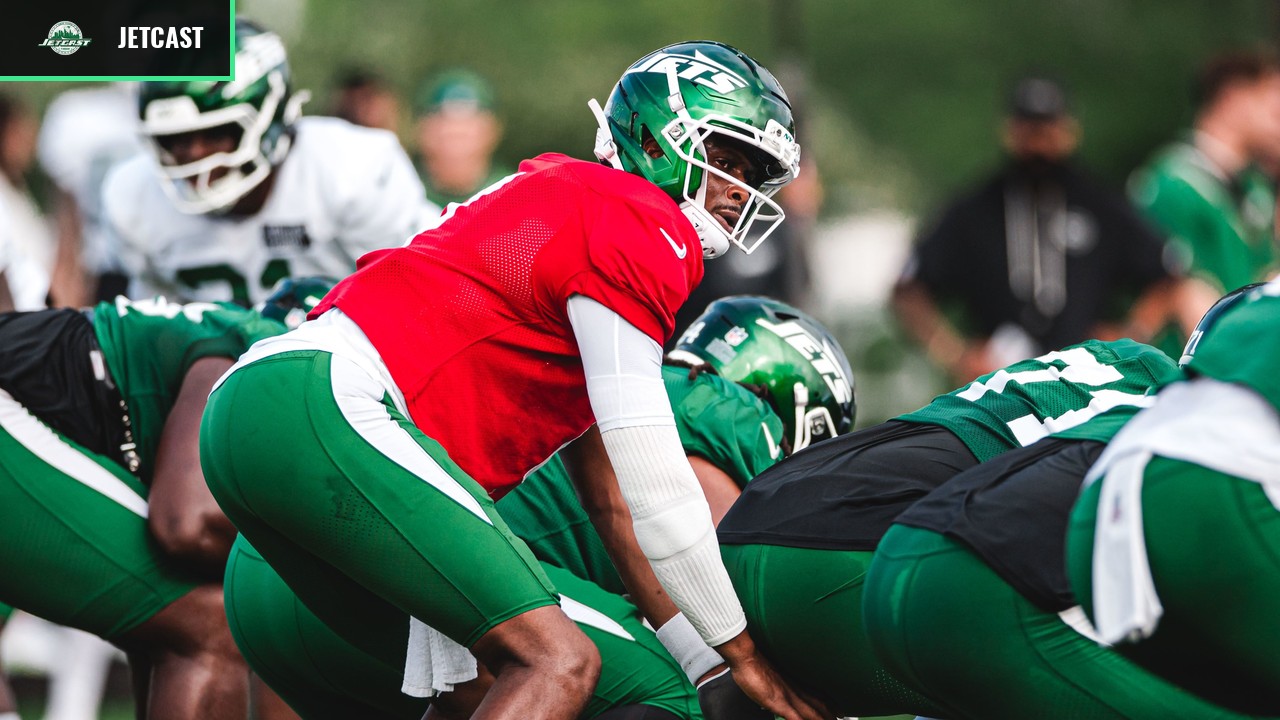
Jets training camp Day 8 offered a useful warning against treating one opening drive as a complete verdict. The first-team offense began Saturday’s controlled scrimmage with a touchdown, then gave away its rhythm through pressure, penalties and missed execution. Isaiah Williams remained the clearest positive, while the defense and Cade Klubnik each produced answers later in the practice. The result was less a clean win for either side than a sequence worth separating carefully.
The controlled scrimmage opened with a touchdown
The format changed the emphasis after the lighter Day 7 practice. Hughes reported that the opening drive covered 65 yards in four plays, with Geno Smith completing all three of his passes and Isaiah Williams scoring from 36 yards after a deflection. That was Hughes’ live chart of the drive, not an official team statistic.
The touchdown also needs its immediate qualifier. Cimini reported the same four-play, 65-yard series and 36-yard score, but judged that the play should have been stopped because David Bailey arrived for what would have been a sack. The offense earned the result within the scrimmage mechanics. It did not provide uncontested proof of a clean rep.
The first-team offense lost its rhythm
The early efficiency extended briefly. Hughes charted Smith at 5 of 5 for 81 yards and a touchdown after two drives. The third series brought a delay of game and three incompletions, including two passes Hughes described as bad, while his live account also noted a drop on the first. On the fourth drive, the offense reached the 4 before holding and two incompletions ended the threat, according to Hughes.
That sequence matters more than a single final number. Three later drives from the 25 ended three-and-out, with Hughes charting Smith at 2 of 5 for 10 yards in that segment. The final reporter-generated practice chart was 12 of 20 for 157 yards and one touchdown, independently reported in Hughes’ completed account and Cimini’s completed summary. It was not an official Jets statistic. Cimini also described penalties and pressure as parts of a sloppy operation, which makes the decline collective rather than reducible to one player.
Isaiah Williams kept forcing his way into the plan
Williams supplied the stable thread through the uneven offense. Hughes reported four catches for 48 yards and a touchdown with the first team and called him that group’s leading receiver. Hughes later offered the more aggressive evaluation that Williams had looked like the Jets’ second-best wideout during the summer. That is Hughes’ assessment, not a team designation or a settled depth-chart decision.
Aaron Glenn’s response nevertheless showed why Williams is becoming difficult to ignore. Hughes reported Glenn saying Williams “demands reps” and that the staff needed to “make sure he’s involved”. Cimini then reported that Klubnik connected with Williams for 66 yards to help set up the final touchdown. Those are substantial practice notes. They still do not award Williams a starting job or roster spot, questions that belong in the broader 53-man roster conversation.
The defense controlled the later red-zone work
The defense’s strongest stretch came after the offense’s quick beginning. Cimini reported that the starting defense controlled three straight drives beginning at the plus-25, with pressure and Bailey among the factors. Hughes’ account of the corresponding segment recorded three three-and-outs and several errant throws. The distinction is important: defensive disruption was real, but offensive inaccuracy and penalties also contributed.
The next goal-to-go period sharpened that split. Hughes reported three Breece Hall runs, two false starts and no touchdown before Glenn removed the offense. That was a poor offensive sequence, not evidence that every failed play belonged solely to the defense. Compared with the red-zone work from Day 6, Day 8’s later periods showed how quickly pressure and self-inflicted mistakes can compound. They did not settle what this unit will become.
Cade Klubnik recovered from an early interception
Klubnik’s practice began badly. Hughes reported Dane Belton’s interception, while Cimini added that Jordan Clark broke up the pass and the throw was behind the receiver. That attribution preserves the play’s texture without turning Belton’s takeaway into a new starting-lineup declaration.
The response was productive. Cimini reported a 50-yard Klubnik touchdown drive against the starting defense, finished by a 14-yard score to Pritchett. Later, Hughes reported an 11-yard back-shoulder touchdown to Woods that ended practice after Williams’ large gain. Klubnik recovered within this practice, which is meaningful but narrower than the broader Klubnik development test. One interception and two touchdown drives cannot settle QB2.
David Bailey’s ankle injury appears limited
Bailey’s pressure showed up throughout the reporters’ accounts, but the closing concern was his ankle. Hughes reported that Bailey limped off and later jogged on the sideline. Cimini saw him return from the injury tent carrying his helmet. Those observations were encouraging, though neither amounted to medical clearance.
Glenn’s first comments were similarly optimistic but preliminary. Hughes reported Glenn calling it an ankle injury and saying Bailey would be fine. Cimini later wrote that Glenn leaned toward a day-to-day label while admitting he did not yet know for sure. That uncertainty controls the conclusion. The update appears limited based on what was reported Saturday, but it is not a diagnosis, guaranteed availability or firm timetable. As with the offense’s uneven day, the responsible reading is to note the evidence and stop before prediction.