



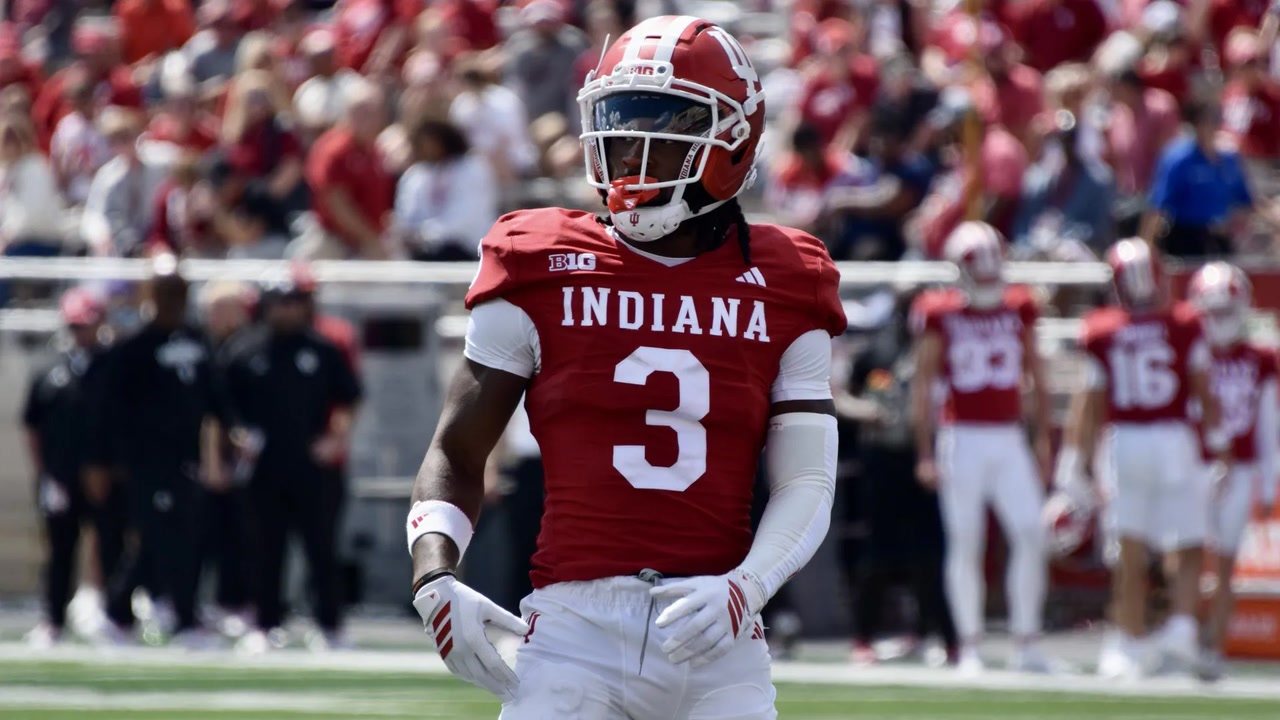
Omar Cooper Jr arrives at Jets training camp with a useful question attached to him: can versatility become a reason to dress, rather than a pleasant line on a receiver profile? The official roster lists the Indiana rookie as a 6-foot, 199-pound wide receiver wearing No. 83. Those details establish who he is, not what his role will be. Camp must supply that answer.
The timing of the question is straightforward. NFL.com recently framed an official interview around how Cooper’s versatility adds to the Jets receiver room. The accessible page does not provide a transcript, so there is no need to manufacture a quote or turn a video title into a promise. The framing itself is enough. The Jets need to learn whether Cooper can solve several small problems well enough to become part of a weekly plan.
Why Omar Cooper Jr.’s versatility matters
Receiver versatility is often discussed as though moving around the formation automatically creates value. It does not. Alignment flexibility matters when a player can execute the assignment that comes with each location. Working outside, reducing a split, or lining up inside can change releases, route spacing, blocking angles, and coverage indicators. A player who understands those changes gives the offense options. A player who merely occupies several spots gives the offense a longer list of possibilities.
That distinction is especially relevant for a rookie trying to earn trust. Cooper may not need one perfect positional label if he can show that coaches can place him where a particular concept requires him. The weekly answer could be modest: a reliable alignment, a clean route, a useful block, or a special teams assignment handled without drama. Versatility becomes meaningful when it reduces the number of substitutions or contingency plans needed around him.
This also fits the broader organizational question discussed in JetCast’s look at Darren Mougey and the Jets’ roster vision. Flexible players can support a coherent plan, but only when the flexibility is functional. Collecting interchangeable labels is not the same as building interchangeable skills.
Where Cooper fits in the Jets receiver room
The honest answer is that his fit has to be earned. The official roster identifies Cooper as an active-status rookie wide receiver, but that designation should not be stretched into a depth-chart conclusion, a final roster guarantee, or a game-day role. Training camp is where the Jets can test him against the practical demands of their offense and their special teams units.
A recent Jets training camp 53-man roster projection included Cooper in a larger roster exercise. That is useful context, not a verdict. Projections describe possible constructions before the evidence is complete. Cooper still needs to provide the evidence that makes one construction preferable to another.
His path could involve serving as a connector between receiver roles rather than claiming one narrowly defined job. If he can learn multiple alignments and preserve the timing of a play from each one, the staff may have more ways to include him. If the execution changes noticeably when he moves, the flexibility loses its point. The fit is therefore less about where Cooper can stand and more about which assignments the Jets can trust him to complete.
What he must prove during training camp
First, Cooper would need to show assignment reliability. A versatile receiver carries a larger mental burden because formations can alter splits, motions, route conversions, and blocking responsibilities. The attractive version of flexibility lets an offense disguise intent. The unattractive version creates hesitation before the snap. Camp practices should reveal which version the Jets are dealing with.
Second, the details have to survive contact with competition. Route depth, spacing, releases, hands, and effort as a blocker are not decorative parts of the evaluation. They determine whether alignment flexibility helps the quarterback and the rest of the formation. Reliability is not glamorous, but a rookie fighting for a supporting role does not need glamour nearly as much as he needs repeatable work.
Third, special teams could matter. A reserve receiver who can contribute outside the offense gives the staff another reason to keep developing him. That does not mean Cooper has already earned such a role. It means special teams value belongs in the test, alongside his receiving assignments. JetCast made a similar broader point when examining which Jets rookie could matter in 2026: immediate relevance is often tied to a specific job, not simply to long-term appeal.
Why versatility does not guarantee targets
Targets are earned inside an offensive structure. A receiver can know several positions and still sit behind teammates who perform particular jobs better. He can also align correctly without creating separation, finishing a route on time, or giving the quarterback a dependable picture. Versatility may open the door to evaluation, but execution decides whether the door stays open.
There is also a difference between roster utility and passing-game priority. The Jets could value Cooper’s ability to cover several assignments without designing touches for him. That would still be a form of usefulness, especially for a rookie, but it should not be confused with a promised workload. The coaching question is not how many ways Cooper can be described. It is whether any of those descriptions produce an answer the offense actually needs.
The same restraint applies when comparing different roster bets. JetCast’s analysis of Adonai Mitchell and the Jets offense concerns a different player and a different evaluation. Cooper’s case should remain his own. His possible value comes from proving dependable across assignments, not from borrowing expectations attached to another receiver.
What a successful rookie season would look like
A successful season for Cooper should not be reduced to an invented statistical threshold. The more reasonable standard is qualitative. Does he leave his rookie year with a role the Jets understand? Can the staff trust him in more than one alignment? Does he handle the uncelebrated work that allows him to stay available for an offensive package or a special teams assignment? Those outcomes would show progress without pretending that a large target share is the only acceptable result.
Success could also mean turning early uncertainty into a clearer developmental path. A rookie may begin camp as a collection of traits and possible uses. By the end of the process, the Jets should know which uses are real, which require more work, and whether Cooper’s flexibility makes weekly preparation easier. That is a sensible test because it connects development to an actual football function.
Cooper’s draft status, expectations, and projections cannot complete that test for him. Training camp can. If alignment flexibility is paired with reliable execution and special teams value, he could give the Jets a practical depth option. If those pieces do not hold together, versatility will remain a description rather than a role. For now, that distinction is the story.